Ragdoll color and pattern guide
Ragdoll colors & patterns seal, blue, mitted, bicolor and colorpoint
In Ragdoll descriptions, color and pattern are two different things. Seal and blue describe the color family, while colorpoint, mitted and bicolor describe the placement of points and white. This guide organizes the most common terms using current TICA breed information.
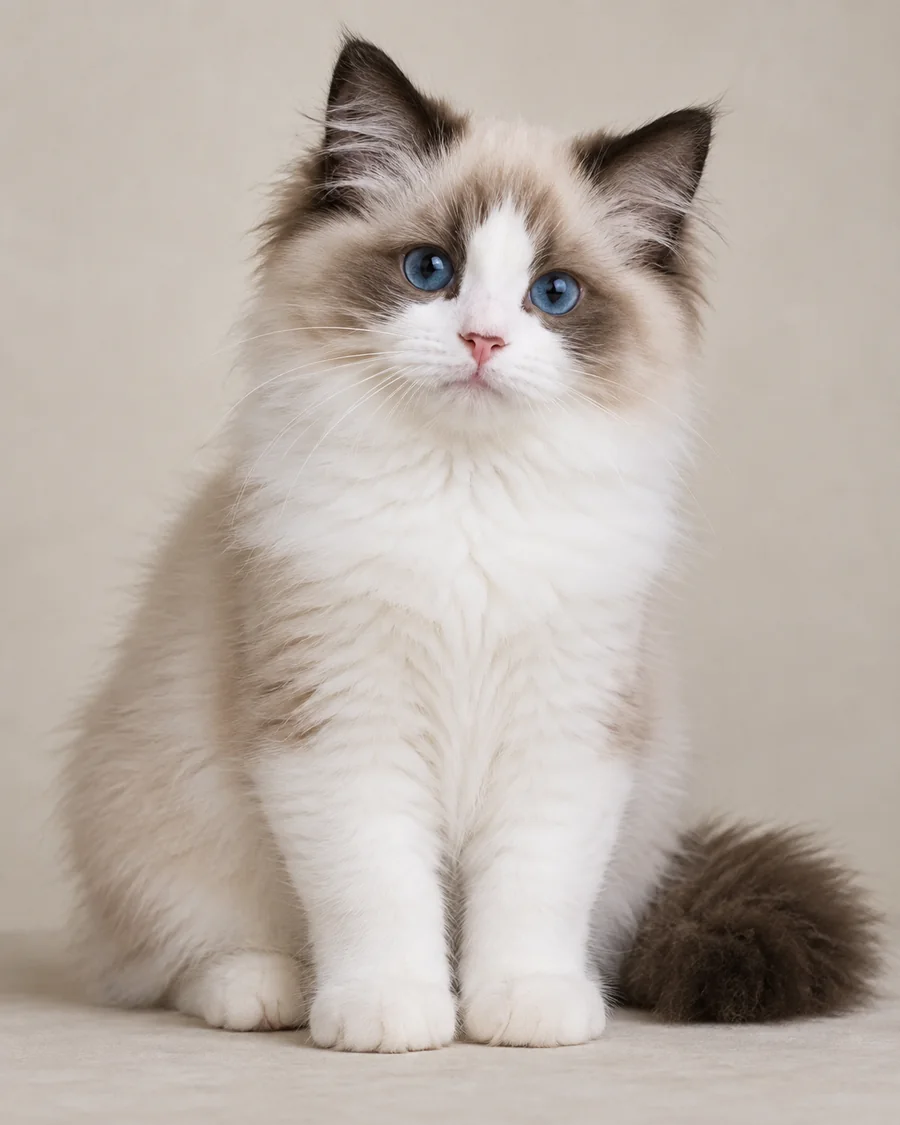
Color vs pattern
How to read Ragdoll color and pattern names
Color and pattern are not the same
A description such as “blue bicolor” combines two pieces of information: blue identifies the color family, while bicolor describes the distribution of white and pointed color. This makes pedigree and breeder descriptions much easier to understand.
Seal and blue — two familiar colors
Seal gives deeper, warm dark-brown points, while blue is the cooler diluted version with a blue-grey tone. TICA also recognizes other pointed Ragdoll colors including chocolate, lilac, red, cream, cinnamon and fawn.
Colorpoint — no white markings
In the colorpoint pattern, darker color appears on the face, ears, legs and tail while the body stays lighter. White markings are not part of the colorpoint pattern.
Mitted — white mittens and boots
Mitted is a pointed pattern with white mittens on the front paws, white boots on the hind legs, a white chin and a white belly stripe. A small facial blaze may also occur.
Bicolor — more white and an inverted V
Bicolor has more white, including the chest, legs, belly and ruff, together with the characteristic white inverted V on the face. This distribution of white separates bicolor from mitted and colorpoint.
Lynx / tabby — striped point markings
“Lynx” is a common breeder and search term for striped point markings; TICA uses tabby terminology. Tabby markings can combine with a color and a white pattern, so descriptions may include seal or blue together with tabby and bicolor or mitted.
Tortie — an additional color variation
Tortie describes a color variation in which two colors appear within the points. It does not replace the white pattern designation: a cat can still be mitted or bicolor.
Ragdoll vs mink / Cherubim
This page focuses on classic blue-eyed pointed Ragdolls (RD). Mink, sepia and traditional categories belong to the same TICA Ragdoll Breed Group but are registered as Cherubim (CB), which KittyHello explains in a separate guide.
Color
Seal, blue and the other color names describe the color family of the points.
Pattern
Colorpoint, mitted and bicolor describe the distribution of points and white.
Ragdoll RD
Classic pointed Ragdolls have blue eyes; mink and sepia are covered separately under Cherubim.
FAQ
Common questions about Ragdoll colors and patterns
What is the difference between seal and blue Ragdoll?
Seal has warmer dark-brown points, while blue is a lighter, cooler diluted version with a blue-grey tone. Color intensity continues to develop as the cat matures.
What is the difference between mitted and bicolor?
Mitted has white front mittens, white hind boots, a white chin and belly stripe. Bicolor has much more white, including the legs, chest, belly and ruff, plus the characteristic white inverted V on the face.
What does colorpoint mean in Ragdolls?
Colorpoint describes darker points on the face, ears, legs and tail with a lighter body and no white markings.
What does lynx Ragdoll mean?
“Lynx” is a common term for striped point markings; TICA uses tabby terminology. Tabby markings can be combined with a color and a pattern such as bicolor or mitted.
Do Ragdoll kitten colors change with age?
Yes. Ragdoll kittens are born very light and the points and contrast develop gradually, so the adult color is easier to judge later.
Does Ragdoll mink belong on this page?
Mink is related through the Ragdoll Breed Group, but under current TICA classification mink cats are registered as Cherubim (CB). KittyHello keeps a separate mink / Cherubim guide to avoid mixing RD and CB terminology.
Continue exploring
See the colors in practice
Open Litter A to see kittens provisionally assessed as seal mitted, blue bicolor and blue mitted, or continue to the dedicated mink / Cherubim guide.